
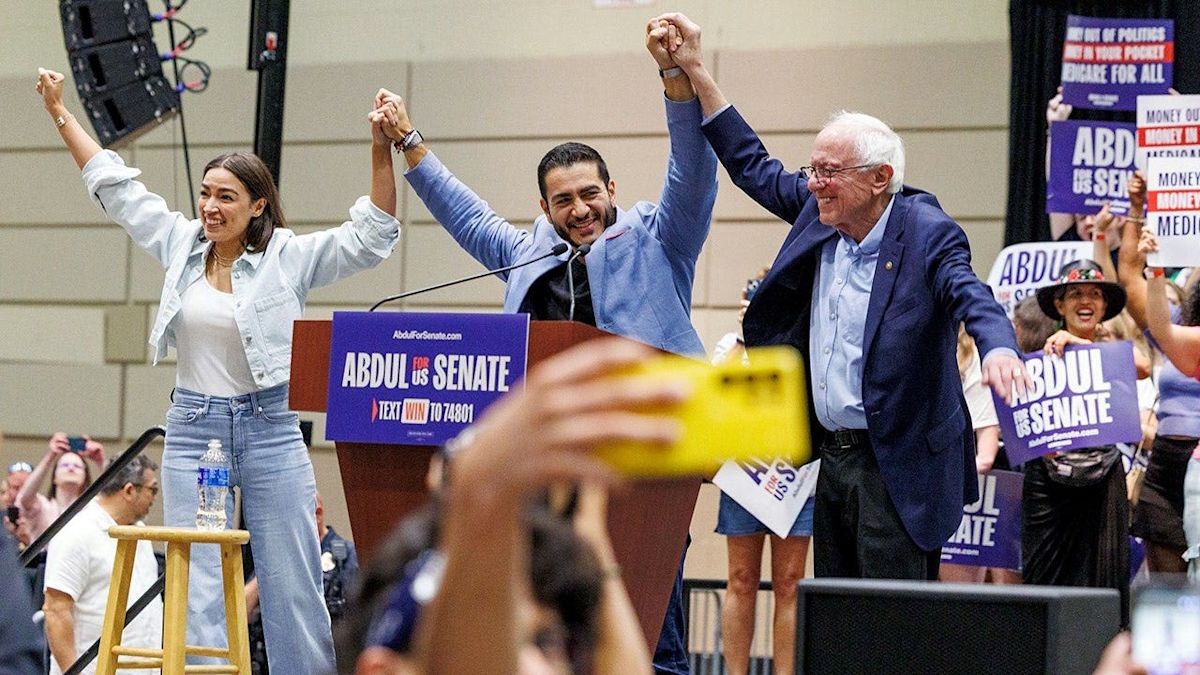
Sen. Bernie Sanders is pointing a finger at his own party. In a new interview with Politico Playbook, the Vermont independent claimed that a small but powerful group of Democratic leaders and donors would actually be fine seeing Michigan Senate nominee Abdul El-Sayed lose in November. The reason, he argues, is that El-Sayed represents a progressive threat to wealthy interests and to the party's current approach to Israel.
El-Sayed, who narrowly won the Democratic primary over Rep. Haley Stevens, has spent the last week fending off questions about his ties to far-left streamer Hasan Piker. Piker drew widespread condemnation from Democratic leaders after making remarks about American Jews and Israel. But Sanders dismissed the controversy, telling Playbook that the real issue is about who controls the party's direction.
“You're talking about a small number of people who are at the head of the Democratic Party. You're talking about the donor class,” Sanders said. “Are they less than enthusiastic about Abdul? Yes, they are.”
Sanders went further, suggesting that some Democrats view El-Sayed and candidates like him as a direct challenge to the party's establishment, including its support for Israeli Prime Minister Benjamin Netanyahu's government. He framed the tension as a fight between grassroots progressives and an entrenched political class.
Democratic strategists push back on Sanders' framing
Not everyone in the party agrees with Sanders' assessment. Yemisi Egbewole, a Democratic strategist and former Biden White House chief of staff, told Fox News Digital that the party's focus is on winning the Senate majority, not internal drama.
“Dems want a majority in the Senate. El-Sayed apologized for his comments about the Temple Israel attack and hasn't campaigned with Hasan. No one is as caught up in this oligarchy business as Sanders is,” Egbewole said. “Stevens lost. She endorsed Abdul. It's now his job to win those voters.”
That endorsement matters. Stevens, who had been the more moderate choice in the primary, has since rallied behind El-Sayed, even as she condemned Piker's remarks. The question now is whether El-Sayed can bring her supporters into the fold for the general election.
Republicans call El-Sayed a national security risk
The GOP is not letting the controversy slide. Natalie Baldassarre, the RNC's national press secretary, rejected Sanders' defense of El-Sayed in a sharp statement to Fox News Digital.
“Abdul El-Sayed is a terrorist bootlicker who downplayed 9/11, pals around with a radical streamer who thinks our country deserved it, and whose mother worked for an organization that funneled money to Osama bin Laden to orchestrate it,” Baldassarre said. “His presence in the Senate would absolutely pose a national security threat, and it's no surprise that Democrats are losing their minds at Bernie for propping up another unelectable extremist.”
Those are strong words, and they reflect the intensity of the attacks El-Sayed is facing. But the candidate himself is trying to steer the conversation back to kitchen-table issues.
El-Sayed apologizes and pivots to Michigan voters
At the Michigan Democratic Party convention over the weekend, El-Sayed faced a barrage of questions from four reporters about Piker. He pushed back, arguing that the focus should be on what matters to Michigan families.
“We're in the state of Michigan. If you want to make this race about a streamer in California, I just think you're missing the boat,” El-Sayed said. “This is about affordability in Michigan. This is about seeing a doctor in Michigan. This is about Donald Trump's disastrous policies in Michigan. That's what I'm focused on right now.”
He also apologized for remarks he made after the March terrorist attack on a Michigan synagogue. El-Sayed had said, “Hurt people, hurt people,” a comment that drew criticism from Michigan Democrats, including Attorney General Dana Nessel.
“To anybody who feels like my comments may have been hurtful, I'm really sorry. That was not my intention. We condemned that terrorist attack. We condemned it outright,” El-Sayed said. “What I was trying to do was offer context for why it happened, but it wasn't the time for context, and you don't ever want to trample somebody's pain.”
What the polls say about the Michigan Senate race
Despite the internal party drama, the race remains tight. An August Fox News poll showed Republican nominee Mike Rogers leading El-Sayed 51% to 47%, within the margin of error. A subsequent AARP survey also showed the candidates in a statistical dead heat.
Partisan loyalty is high on both sides: 91% of Democrats back El-Sayed, while 96% of Republicans support Rogers. That means the race could come down to independents and undecided voters, many of whom may be paying more attention to the economy than to streaming controversies.
Sanders urged El-Sayed to keep his focus on economic issues, saying that's the path to victory.
“Stay on the issues that impact working families in Michigan,” Sanders said. “Do that, you're going to win and I think he will.”
Is the Democratic Party really divided on El-Sayed?
The short answer is yes, at least at the top. Sanders' comments reveal a real tension between the party's progressive wing and its more moderate establishment. But whether that tension translates into a willingness to lose a Senate seat is another question entirely.
Democratic leaders like Hakeem Jeffries, Cory Booker, Elissa Slotkin and Jacky Rosen have all condemned Piker's remarks. Yet they have not called on El-Sayed to distance himself further, and Stevens has endorsed him. The party seems united on the goal of winning the Senate, even if there are disagreements about how to get there.
For now, El-Sayed is trying to move forward. The question is whether the controversies will follow him all the way to November.
Frequently asked questions
Who is Abdul El-Sayed?
Abdul El-Sayed is the Democratic nominee for U.S. Senate in Michigan. He is a physician and former Detroit health director who narrowly defeated Rep. Haley Stevens in the August primary.
Why is Bernie Sanders defending El-Sayed?
Sanders has backed El-Sayed since the primary and sees him as a progressive candidate who challenges the party's donor class and its foreign policy approach, particularly regarding Israel.
What did Hasan Piker say that caused controversy?
Piker, a popular left-wing streamer, made remarks about American Jews and Israel that drew widespread condemnation from Democratic leaders, including House Minority Leader Hakeem Jeffries and several senators.
Who is running against El-Sayed in the general election?
Republican nominee Mike Rogers, a former congressman, is El-Sayed's opponent. Recent polls show the race is within the margin of error.