Campbell's cut its quarterly dividend by 36% on September 3, 2026, dropping the payout from $0.39 to $0.25 per share to accelerate debt repayment, and the move has scrambled the calculus for retirement investors comparing pantry staples.
The decision, first reported by Yahoo! Finance, contrasts sharply with J.M. Smucker, which raised its quarterly payout to $1.12 in July and then lifted its fiscal 2027 outlook after quarterly results beat expectations. For anyone building a retirement income plan around household-name food stocks, the gap between these two companies now tells a story about debt, cash flow, and who actually keeps their promises to shareholders.
What Campbell's Dividend Cut Means for Retirees
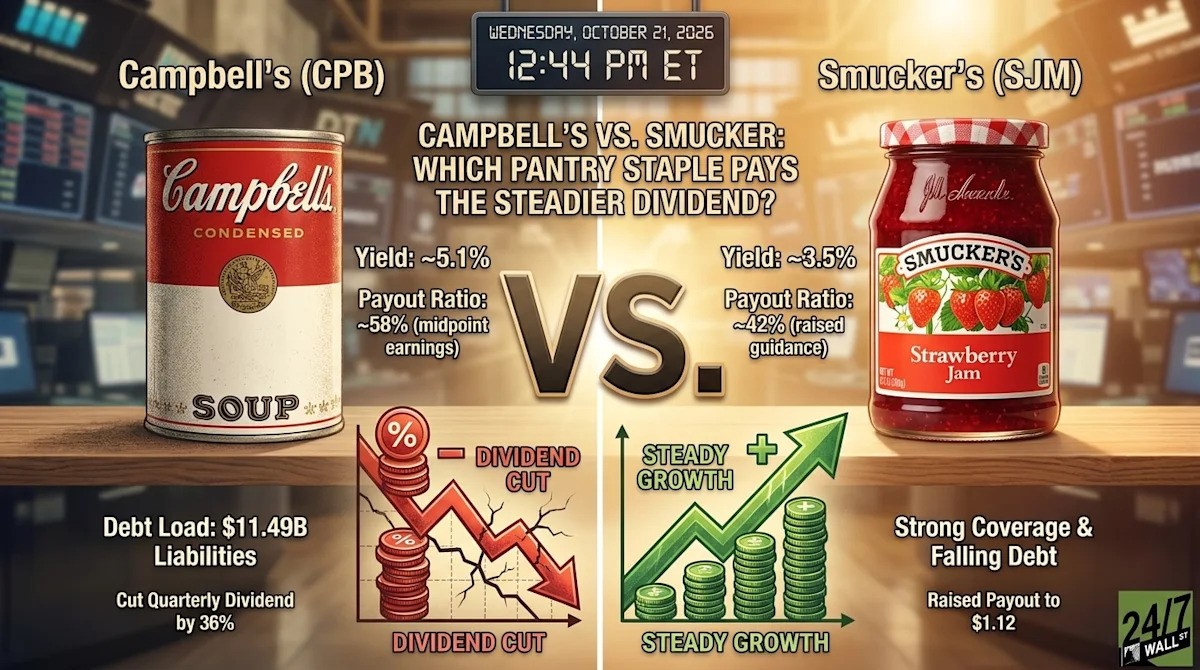
The cut leaves Campbell's with a forward annual payout of $1 per share. At its October 22 price of $19.69, that works out to a yield of roughly 5.1%, according to 24/7 Wall St., whose analysis Yahoo! Finance carried. Smucker's forward payout of $4.48 at $127.91 yields about 3.5%.
On raw income alone, Campbell's still pays more per dollar invested. But that headline number hides a lesson income investors keep relearning: an unusually high yield is often the market pricing in a cut. Jim Cramer flagged exactly that in May, when Campbell's yielded 7.56%.
“People, you don't get those kinds of deals unless people are worried that the dividend will need to be cut.”
He was right, months before the board acted. The pattern, a yield that looks too good to be true because it is, is the classic shape of a dividend trap.
Why Smucker's Payout Looks Safer Right Now
The stronger case for Smucker rests on coverage. Campbell's guided fiscal 2027 adjusted earnings to $1.65 to $1.80 per share, down from $2.17. That puts even the reduced dividend at roughly 58% of midpoint earnings, a thin cushion for a company still carrying heavy debt.
Smucker's raised guidance of $10.50 to $11.00 per share covers its payout at about 42%. The two stocks trade at similar valuations, about 11 times earnings for Campbell's and 12 for Smucker, so investors pay almost nothing extra for the better protection.
Smucker's balance sheet widens the gap further. The company raised its free cash flow target to about $1.1 billion and hit a three-times leverage ratio in the first quarter while working toward roughly $500 million of debt paydown this year. Coffee, which grew 13%, and the Uncrustables brand are funding the dividend. Its CEO said the company is “increasing our net sales, adjusted earnings per share, and free cash flow outlook for the fiscal year.”
The risks on Smucker's side are real: coffee price swings, mid-single-digit inflation, and a $0.60 per share net benefit from tariff refunds that will not repeat next year.
Campbell's Debt Problem in Numbers
Campbell's carries $11.49 billion in total liabilities against $3.85 billion of equity. It expects interest expense to rise about $25 million because of the La Regina acquisition, and a $500 million bond comes due in March. Operating cash flow fell 8.13% to $1.039 billion, and management has warned of a “fairly sharp decline” in first-quarter earnings.
The company's own leadership is not pretending otherwise. Campbell's CEO admitted “our performance is not where it needs to be,” and guidance calls for adjusted EBIT to fall between 12% and 7% this year.
For a firm that once symbolized dependable American consumer staples, the numbers describe a turnaround in progress rather than a finished recovery. Management is “strongly considering” a hybrid security to refinance the March bond, a signal that conventional financing is getting harder to come by on agreeable terms.
Track Record: Who Actually Protects Shareholders
History favors Smucker decisively. Its quarterly dividend has climbed from $0.15 in 1999 to $1.12 today, with no reduction in the regular payout in more than two and a half decades, according to AOL's finance desk. Campbell's held at $0.39 for seven quarters before this fall's cut, and its record includes an earlier reduction, from $0.225 to $0.1575 in 2001.
Share prices have followed the same path. Campbell's stock is down 32.5% over one year and 47.24% over ten. Smucker is up 26.36% and 35.12% over the same periods.
The Verdict for Income Investors
For retirees who depend on rising income, Smucker is the clear winner: better coverage, a falling debt load, a raised cash flow target, and a payout that kept growing through tariffs and the Hostess losses. Campbell's now appeals mainly to contrarian income investors chasing the higher 5.1% yield and willing to absorb turnaround risk.
There is a broader lesson here for anyone managing a retirement portfolio in an economy where consumer companies are squeezed by inflation, debt, and tariff whiplash. Dividend reliability is not about the biggest yield on the screen. It is about cash flow, leverage, and a management team with a record of protecting the payout when conditions turn. A company that pays you 5% today but cuts tomorrow leaves you worse off than one that pays 3.5% and raises every year.
What happens next will test both firms. Campbell's must refinance its March bond and show its Snacks division can stabilize. Smucker must prove coffee momentum lasts once the tariff refunds roll off, and investors will watch for word on buybacks.
Frequently Asked Questions
How much did Campbell's cut its dividend in 2026?
Campbell's cut its quarterly dividend 36% on September 3, 2026, from $0.39 to $0.25 per share, to pay down debt faster.
What is Campbell's dividend yield after the cut?
Campbell's forward annual payout of $1 per share yields about 5.1% at its recent price of $19.69.
Which stock pays the steadier dividend, Campbell's or Smucker?
Smucker. Its fiscal 2027 guidance covers the dividend at about 42% of earnings versus roughly 58% for Campbell's, and Smucker has not cut its regular payout since 1999.
What are the biggest risks to Smucker's dividend?
Coffee price swings, mid-single-digit inflation, and the loss of a $0.60 per share tariff refund benefit that will not repeat in the next fiscal year.