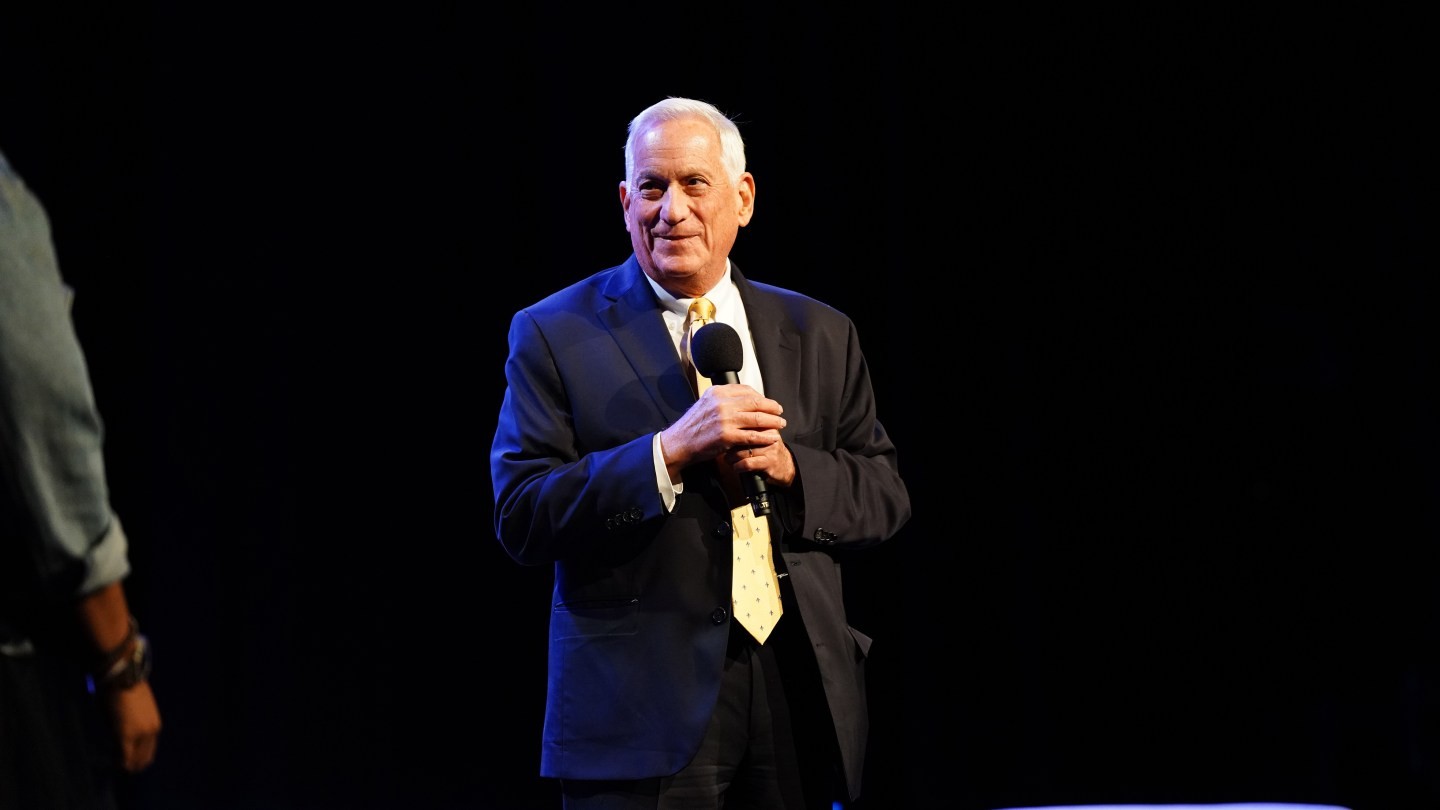
Walter Isaacson, the biographer behind best-selling books on Steve Jobs and Elon Musk, launches a new podcast on Tuesday, Oct. 20, that puts the most powerful people in artificial intelligence in the interviewer's chair. The show, The Builders with Walter Isaacson, opens with a Musk interview and runs twice weekly into January, according to The Hollywood Reporter.
The guest list reads like a map of who currently holds power over a technology reshaping daily life: Musk, Palantir co-founder Peter Thiel, Palantir CEO Alex Karp, AI researcher Fei-Fei Li, Anthropic co-founders Dario and Daniela Amodei, and Oculus VR creator Palmer Luckey. Kaleidoscope produces the show in partnership with Ramp, with distribution through iHeartPodcasts.
Why Isaacson Chose a Podcast Over a Book
Isaacson told The Hollywood Reporter that the speed of AI forced his hand. A biography takes years; the technology is moving in months.
“AI is the most transformative technology we've had maybe since the advent of electricity, 130 years ago, and it's happening so fast that I wanted to get to have a deep dive with the people who are creating it and do it in a more timely manner than a book,” Isaacson said.
He also came with a pointed question for his subjects: why build autonomous agents at all if no one can guarantee they can be controlled?
“I particularly wanted to push back on autonomous agents getting out of control and why are we building them if we're not sure we'll be able to control them,” he said.
What Musk Told Isaacson This Time
The premiere episode arrives as Musk remains a singularly divisive figure, both as a technology executive and as a political actor. According to Axios, which obtained an excerpt ahead of the launch, Musk told Isaacson that “the only way we're going to solve the national debt is with AI and robots.” Axios reported the exchange on Oct. 17.
Isaacson has faced criticism since his 2023 Musk biography for not pressing harder on his subject's darker impulses. Asked whether Musk has changed since the book, Isaacson was blunt: he has not.
“I think the Elon Musk you see in the book is the Elon Musk you see today,” Isaacson said. “Somebody prone to demon mode, also to great engineering triumphs and imagination, and also to having dark conspiratorial political views that I think come from spending too much time wallowing on X as opposed to actually touching grass.”
Isaacson noted that Musk was drawn to conspiracy-heavy corners of the internet before he bought Twitter, and that the platform's dynamics are self-reinforcing. The observation matters beyond biography. When the owner of one of the world's largest information platforms is shaped by that platform's worst dynamics, the public conversation itself bends.
The Real Question: Who Checks This Power?
For anyone concerned with democratic accountability, the most revealing part of Isaacson's interview is what it confirms about the gap between what AI leaders privately believe and what they publicly build.
“When I talked to Dario and Daniela Amodei, or even Elon Musk, they all think that this is a danger, and we have to find some ways to have guardrails, or regulation, or self-regulation, or a pause,” Isaacson said. “And yet, even though they individually feel that way, it's hard for our governments and our institutions to react quickly enough.”
That is the civic problem in a single sentence. The people racing to build these systems know the risks. They say so on the record. But as Isaacson pointed out, citing the history of Standard Oil, IBM and Microsoft, competitive races do not produce voluntary restraint. Regulation has historically come from government stepping in to set “rules of the road.”
Isaacson also named the public mood plainly: a backlash driven by the sense that the technology is not serving people, plus “an understandable feeling that a small group of people are in control, and nobody is, and there's not enough checks on their power.”
A Human-Machine Philosophy Worth Recovering
Isaacson's deeper argument draws on his earlier book The Innovators. The pioneers of personal computing, Steve Jobs above all, saw computers as tools that would amplify human imagination. Jobs called them “a bicycle for the mind.”
Building autonomous agents that replace human judgment breaks with that tradition, Isaacson argued, a lineage running from Ada Lovelace and Doug Engelbart through Jobs. His conclusion: return to the principle of humans and machines working in partnership, rather than creating machines that operate beyond meaningful human control.
That framing lands squarely in a debate that citizens, not just engineers, should be having. The question is not only whether AI works, it is who it works for, and who gets a say. For readers tracking how technology concentrates power and who gets left behind, the series promises raw material for exactly that argument, alongside coverage like our look at who gets excluded when automation reshapes everyday systems.
What to Expect From the Series
The Musk episode drops Tuesday, Oct. 20, with new episodes twice weekly through January. Isaacson is still taping interviews through the fall, so the guest list may grow. He has also said he will keep writing biographies alongside his podcast work, which already includes the earlier On Musk series with Kaleidoscope.
Isaacson described Peter Thiel as one of the more surprising interviews, noting that the same polarizing qualities that mark these founders show up in the technologies they create. The brilliance and the divisiveness, he suggested, are not separate stories. They are one story.
Frequently Asked Questions
When does The Builders with Walter Isaacson premiere?
The podcast launches Tuesday, Oct. 20, 2026, with an episode featuring Elon Musk, and continues twice weekly into January 2027.
Who are the guests on Isaacson's new podcast?
Announced guests include Elon Musk, Peter Thiel, Alex Karp, Fei-Fei Li, Dario and Daniela Amodei, and Palmer Luckey, with more interviews being taped through the fall.
Where can listeners find the show?
Kaleidoscope produces the series in partnership with Ramp, and iHeartPodcasts distributes it across podcast platforms.