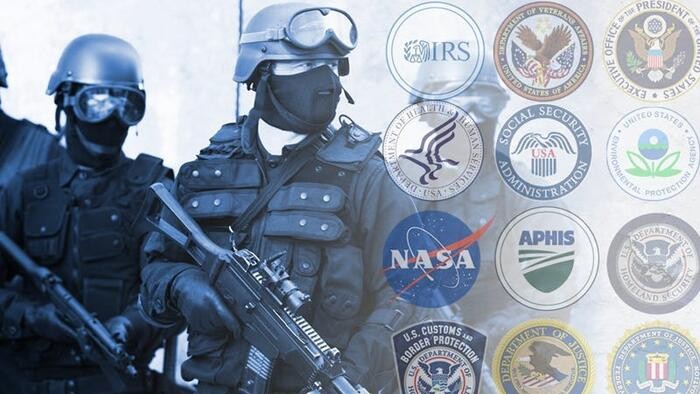
Federal spending on guns, ammunition and military-style gear at nearly 70 non-Defense agencies reached $531 million in fiscal 2026 through August, according to an Open the Books analysis published by Zero Hedge, and the numbers reveal a sharp split: enforcement agencies under the Department of Homeland Security are buying far more hardware, while administrative agencies like the IRS and Social Security Administration are cutting back.
Across the comparable period from October through August, agencies spent $228 million in fiscal 2024, President Joe Biden's final full year, and $278 million in fiscal 2025. The jump to $531 million in fiscal 2026, the first fiscal year of Donald Trump's second term, is driven almost entirely by DHS.
Where the money is going: DHS and ICE
Spending at the Department of Homeland Security on guns and ammunition rose almost 236 percent between fiscal 2025 and fiscal 2026, from $60.8 million to $204.4 million. Immigration and Customs Enforcement alone spent $57.2 million on guns, ammunition, explosives, armor and tactical equipment in fiscal 2026, compared with $15 million and $14.4 million in the two prior years, a nearly fourfold increase.
That figure excludes a $25.1 million sole-source contract awarded in May 2026 to Bi2isolutions for mobile iris scanners and identity-matching services for ICE, which the analysis treated separately because biometric gear is not guns, ammo or body armor.
Other DHS components, including the Coast Guard, Customs and Border Protection, the Secret Service, the Federal Law Enforcement Training Center, the TSA and the Office of Inspector General, all posted increases. The Coast Guard's rise stems largely from two Teledyne contracts totaling $61.9 million for night-vision sensors mounted on MH-65 and MH-60 helicopters.
The drawdown at administrative agencies
Beneath the DHS surge, the data shows civilian and regulatory agencies pulling back. The General Services Administration, the Department of State, Veterans Affairs, the Social Security Administration and the IRS all spent less on weapons in fiscal 2026 than in 2025.
Fourteen agencies cut spending by more than 50 percent year over year, including nine where purchases dropped to zero. The Social Security Administration, the U.S. Mint's Federal Prison Industries, the Food and Drug Administration and the Indian Health Service all zeroed out weapons spending. The Bureau of Reclamation, IRS, Veterans Affairs and the Federal Aviation Administration posted declines between 34 percent and 94 percent.
The top ten decreases add up to more than $41 million in savings, led by the GSA's Federal Acquisition Service, the office that makes bulk purchases for other agencies, with a $15.3 million drop. Because that office buys at scale, its retreat may signal broader reductions ahead across the bureaucracy.
Why does the IRS need guns?
The question is not new. A 2023 Open the Books report found the IRS had spent $35.2 million on guns, ammunition and military-style equipment since 2006, with 2020 and 2021 as peak years at roughly $10 million combined. Those purchases included $2.5 million for ballistic shields and other criminal-investigation gear, $1.3 million for tactical lighting, gear bags, ballistic helmets and body armor, and nearly $1 million for Smith and Wesson rifles and Beretta tactical shotguns.
IRS special agents do carry firearms for criminal investigations, and the agency's recent purchases reflect that narrower mission. Of the $5.7 million the IRS spent over the last three years, $2.7 million went to body armor and $2.1 million to ammunition. Less than $1 million bought batons, helmets, flashlights, backpacks, night-vision binoculars and gun safes, but no guns. IRS weapons spending fell 47 percent between fiscal 2025 and fiscal 2026, a drop of roughly $1.1 million, from $2.4 million to $1.3 million.
A few outliers went the other way
Not every non-enforcement agency cut back. The Department of Energy, which spent about $1.5 million in each of fiscal 2024 and 2025, spent $40 million in fiscal 2026 on unmanned aircraft for the National Nuclear Security Administration. NASA's spending jumped from $9.4 million and $4.2 million in the prior two years to $60.5 million, with $59 million of that going to unmanned aircraft, missile propulsion units, fuel and components for the Artemis moon program during summer 2026. The EPA rose from $155,000 to $1.9 million, mostly for chemical detection instruments.
Why the split matters for democratic oversight
The pattern here deserves public attention, whichever party holds the White House. When agencies whose core mission is processing taxes, benefits and regulation arm up, accountability suffers, and when enforcement spending concentrates in immigration agencies during a crackdown, that concentration deserves scrutiny too. The Just Security litigation tracker documents the legal challenges already mounted against Trump administration actions, several of which touch on immigration enforcement.
Transparent procurement data remains the public's best tool for asking these questions. Open the Books first flagged the militarization of civilian agencies years ago, and the fiscal 2026 figures show that sunlight, plus sustained citizen pressure, can move even the quietest corners of the federal budget. Whether the drawdown at administrative agencies holds, and whether DHS spending keeps climbing, will show up in the end-of-year September figures.
FAQ
How much did federal agencies spend on guns and military-style gear in fiscal 2026?
Nearly 70 non-Defense federal agencies spent $531 million on guns, ammunition and military-style equipment in fiscal 2026 through August, according to Open the Books data reported by Zero Hedge.
Which agency increased weapons spending the most?
The Department of Homeland Security raised gun and ammunition spending nearly 236 percent, from $60.8 million to $204.4 million, with ICE alone jumping to $57.2 million.
Did the IRS cut its weapons spending?
Yes. IRS spending on guns and ammunition fell 47 percent between fiscal 2025 and fiscal 2026, from $2.4 million to $1.3 million.