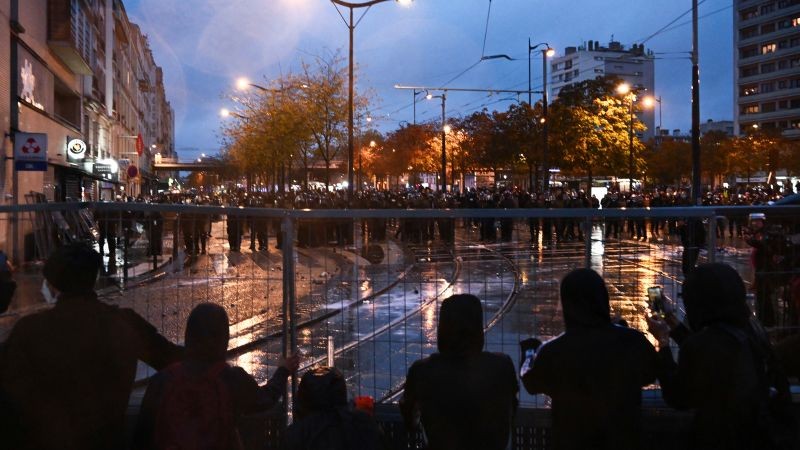
French police detained nearly 1,000 people on Saturday, October 24, as more than 410,000 protesters marched across France for the second consecutive weekend, demanding action on education funding, youth employment and soaring living costs.
The Interior Ministry said about 110,000 of those demonstrators filled the streets of Paris, roughly matching last week's turnout in the capital. Interior Minister Laurent Nuñez said the vast majority of marches proceeded without incident, but the detention figure more than doubled from the 385 recorded a week earlier.
A massive security operation meets a largely peaceful movement
France deployed around 70,000 police officers nationwide, according to CNN International, with SWAT units, helicopters, armored vehicles, police dogs and water cannons positioned ahead of the second round of protests. The show of force came after more than half a million people took to the streets the previous Saturday.
“In Paris, we had a major demonstration that took place peacefully, like most protest marches across the entire country,” Nuñez told reporters. He credited police restrictions for preventing “unauthorized roving protests” and keeping crowds out of city centers.
But the minister also described an “extremely high level of violence” directed at security forces, with projectiles and mortar fireworks thrown throughout the day. Officers remained deployed late into Saturday night to guard against looting, he said. Nuñez acknowledged “some damage or looting of businesses, in very limited numbers,” far less than the previous weekend, and no targeted attacks on public buildings such as town halls or police stations.
Where the clashes happened
After a peaceful march through Paris that ended at the Porte de Vincennes, a crowd of several thousand confronted police, who responded with tear gas and a water cannon, according to a CNN team at the scene.
In Marseille, protesters launched mortar fireworks at officers during running street skirmishes, and looting was reported across the city, including a jewelry store with smashed windows and a pillaged supermarket, according to BFMTV, CNN's French affiliate. In Bordeaux, tear gas drifted across the Place de la Bourse as masked demonstrators hurled objects at police.
Nice saw a different kind of violence: BFMTV reported that dozens of far-right activists physically attacked people protesting peacefully. For a movement rooted in economic grievances, the presence of organized far-right aggressors attacking demonstrators adds a troubling dimension that French authorities will need to address.
What protesters are demanding
The demonstrations have coalesced around concrete demands: greater investment in France's education system, more opportunities for young workers and solutions to surging living costs. These are not fringe grievances. They reflect a generational anxiety about whether the social contract, education, work, and affordability, still functions for people under 35.
The scale of the response matters here. When hundreds of thousands of citizens march for education and economic opportunity, and the state answers with water cannons and armored vehicles, the question of proportionality becomes unavoidable. Nuñez insisted the restrictions prevented chaos, and Saturday did see less property damage than the week before. Yet nearly 1,000 detentions, up from 385, suggests escalation rather than de-escalation.
A general strike looms on November 5
Jean-Luc Mélenchon, leader of the far-left party La France Insoumise, warned that nationwide industrial action will follow if President Emmanuel Macron ignores the protesters' demands.
“A general strike, called by the CGT, looms over the government for the 5th of November,” Mélenchon told BFMTV from the front line of the Paris demonstration.
The CGT, one of France's largest unions, has the capacity to paralyze transport and industry if it follows through. The Guardian's live coverage noted that arrests in France reached around 1,000, a figure expected to rise, while Italian police raided homes in Milan.
The protests are spreading across Europe
Saturday's unrest was not confined to France. Anti-government demonstrations unfolded across the continent, and the cross-border character of the movement may be its most significant feature.
In the Italian cities of Naples, Rome and Milan, stores boarded up their windows ahead of planned protests after looting during earlier demonstrations. The BBC reported that Italian officers fired a water cannon at protesters in central Rome.
In the Albanian capital Tirana, protesters set dumpsters on fire and threw stones and tear gas canisters. In Brussels, students barricaded streets and held up placards as police deployed a water cannon, according to Belgium's public broadcaster VRT. Al Jazeera reported that French police conducted more than 3,000 checks earlier in the day before the arrests began.
Why this matters for anyone who cares about democratic participation
Mass protest is a legitimate instrument of democratic participation, and France's tradition of taking grievances to the street is one of the healthiest expressions of civic power in Europe. The demands on the table, education, youth opportunity, affordability, are precisely the issues that decide whether young people believe democracy works for them.
The risk is a familiar one. When governments meet economic protest primarily with security measures, and when far-right groups are able to attack peaceful demonstrators, the space for constructive political response narrows. Macron has until November 5 to answer the street. If he does not, the CGT's general strike will test whether France's institutions can absorb this discontent or merely contain it.
FAQ
How many people protested in France on Saturday, October 24?
More than 410,000 people demonstrated across France, including about 110,000 in Paris, according to the French Interior Ministry.
How many people were detained?
Nearly 1,000 people were detained nationwide, according to Interior Minister Laurent Nuñez, up from 385 detentions during the previous week's protests.
What are the protesters demanding?
Demonstrators are calling for greater investment in education, more opportunities for young workers and solutions to rising living costs.
What happens next?
Jean-Luc Mélenchon warned that the CGT union will call a general strike on November 5 if President Emmanuel Macron does not respond to the protesters' demands.